
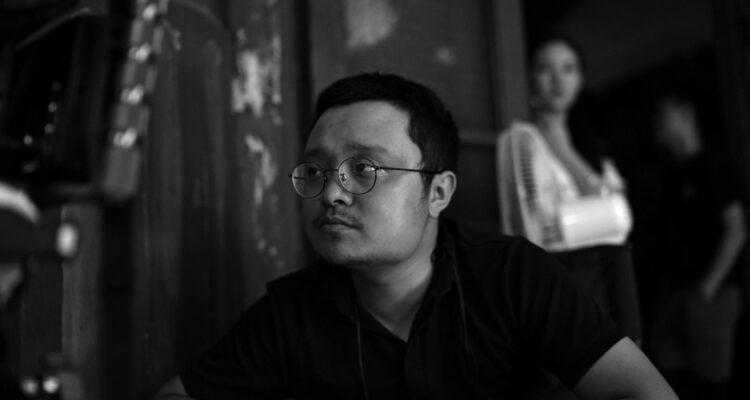
Ein Jahr nach seiner Weltpremiere während der 78. Internationalen Filmfestspiele von Cannes startet Resurrection, der neuste Film des chinesischen Filmemachers Bi Gan am 25. Juni 2026 auch in Deutschland. Kurz vor dem Kinostart sprechen wir mit ihm über die Transformation des Mediums Kino im digitalen Zeitalter, die Rückbesinnung auf fundamentale Fragen menschlicher Existenz und die Ideen und kreativen Impulse seines neusten Werks.
Als du mit der Entwicklung von Resurrection begonnen hast, was war die ursprüngliche Inspiration oder das zentrale Gefühl, das du erkunden wolltest?
Die ursprüngliche Idee entstand eigentlich sehr organisch und auf eine sehr einfache Weise. Ich arbeitete an meinem nächsten Film, der ursprünglich in der Zukunft spielen sollte, und dann fragte ich mich: „Aber was ist mit der Vergangenheit?“ Und genau daraus entstand dieser Film. Bevor ich zu meinem nächsten Projekt übergehe, wollte ich wirklich innehalten, zurückblicken und die vergangenen hundert Jahre Geschichte erneut betrachten.
Du hast das „Movie Monster“ fast wie eine tragische Figur beschrieben, die durch die Ruinen des Kinos wandert, und du hast davon gesprochen, auf die Geschichte des Kinos zurückzublicken. Ist dieser Film eine Reflexion über Filmgeschichte oder auch gleichzeitig eine Form persönlicher Trauer über etwas, das sich verändert?
Ich denke, statt von Trauer zu sprechen, geht es eher, wie schon der Titel des Films sagt, um eine Wiederentdeckung der Geschichte des Kinos. Und genau das versuche ich mit diesem Film zu tun. Deshalb sehe ich ihn nicht als eine Art Elegie oder Nachruf auf die Filmgeschichte oder den Zustand des Kinos, sondern vielmehr als einen Prozess der Wiederentdeckung des Wunders und der Schönheit des Films. Nicht nur durch unsere Augen, sondern wirklich durch alle Sinne, auf eine sehr instinktive und intuitive Weise.
Du arbeitest mit sehr unterschiedlichen filmischen Sprachen aus verschiedenen Epochen. Gibt es bestimmte Phasen der Filmgeschichte, zu denen du emotional eine stärkere Verbindung hast als zu anderen?
Stummfilme und Film Noir sind definitiv etwas, das ich persönlich sehr liebe. Und nicht nur bei diesem Film, sondern auch schon bei meinen beiden vorherigen Filmen kann man den Einfluss von Stummfilmen und Noir erkennen.
Wenn wir über Filmgeschichte und unterschiedliche filmische Traditionen sprechen: Glaubst du, dass der Film ein starkes Wissen über Kino voraussetzt, um emotional vollständig mit ihm verbunden zu sein?
Ich denke nicht, dass es die Aufgabe eines Regisseurs ist, unterschiedliche filmische Sprachen zu benutzen, um unterschiedliche Geschichten zu erzählen. Ich glaube vielmehr, dass die Aufgabe eines Filmemachers darin besteht, eine eigene filmische Sprache zu finden, um Geschichten zu erzählen, die mit den Sorgen, Fragen und alltäglichen Erfahrungen des Publikums resonieren können.
Als ich den Film vor ungefähr einem Jahr bei der Premiere in Cannes gesehen habe, war ich zuerst ziemlich überwältigt, gleichzeitig aber auch sehr eingenommen. Es fühlte sich fast wie eine Art Lernerfahrung an. Ich habe mich gefragt, ob das auch daran liegt, dass deine Filme im Westen oft sehr intellektuell diskutiert werden, mir aber der kulturelle Bezug teilweise fehlt. Reagieren Zuschauer in China anders auf deine Filme, besonders auf diesen, als westliche oder internationale Festivalpublika?
Ich denke, meine Filme sind sehr einzigartig positioniert. Einerseits haben Menschen auf dem lokalen Markt vielleicht weniger Erfahrung mit filmischer Ästhetik und Filmsprache, weshalb es schwieriger sein kann, vollständig in den Film einzutauchen. Gleichzeitig besitzen sie aber ein Verständnis für die kulturellen Elemente, Hintergründe und Kontexte, wodurch es für chinesische Zuschauer leichter wird, sich emotional mit dem Film zu verbinden.
Andererseits sind internationale Zuschauer auf Filmfestivals oder anderen Filmmärkten oft stärker mit der Art von filmischer Ästhetik und Filmsprache vertraut, die ich in meinen Filmen ausdrücken möchte. Dafür fällt es ihnen manchmal schwerer, die kulturell spezifischen Aspekte, Hintergründe und Kontexte nachzuvollziehen oder emotional damit zu resonieren. Also ist die Rezeption verschieden, aber das ist der sehr speziellen Art und Position meiner Filme geschuldet.
Der Film wirkt wie gefangen zwischen analogen Geistern und digitalem Zerfall. Glaubst du, dass moderne digitale Kultur, besonders durch jüngere Zuschauer, die Filme und Unterhaltung über Kurzformate wie TikTok konsumieren, das Kino langsam auslöscht?
Wenn ich mir mich selbst als Filmemacher vorstelle, dann ist das wie ein Maler zu sein. Als Maler kann man verschiedene Wege wählen, um ein Werk zu erschaffen. Man kann mit Ölfarben, Pinsel und Leinwand arbeiten. Oder man benutzt ein iPad und Zeichenprogramme, um genau die Art von Werk zu erschaffen, die man erschaffen möchte. Und beides kann gleich gut sein.
Ich glaube nicht, dass die Technologie selbst das Problem ist. Viele Menschen argumentieren, dass digitale Formate die Arbeit von Filmemachern abflachen, manchmal auf eine sehr abrupte und rohe Weise. Aber ich denke nicht, dass das zwangsläufig so sein muss. Wenn man als Künstler wirklich in der Lage ist, neue Technologien zu nutzen, in diesem Fall digitale Technologien, dann kann man weiterhin Werke erschaffen, die viele Möglichkeiten und multidimensionale Formen des Erzählens besitzen. Digital ist einfach nur eine weitere Art dessen. Vielleicht schafft es sogar noch mehr Möglichkeiten für multidimensionales Erzählen.
Das eigentliche Problem ist, dass durch die allgegenwärtige Nutzung digitaler Technologien nicht nur die Formate digital geworden sind, sondern auch die Art, wie Geschichten erzählt werden, immer eindimensionaler wird. Das ist das Problem, nicht digitale Technologie selbst. Es ist vielmehr diese Verflachung menschlicher Vorstellungskraft und des Erzählens, mit der sich Filmemacher auseinandersetzen und die sie überwinden müssen.
Wenn Resurrection also nicht unbedingt vom Tod des Kinos handelt, sondern eher von Transformation, gibt es für dich dann trotzdem eine idealistische Hoffnung für die Zukunft des Kinos?
Ich denke, dass die Zukunft des Kinos weder vom Tod noch von der Wiederauferstehung des Kinos als Kunstform handelt. Die wichtigere Frage ist vielmehr, wie sich die Fragen und Verunsicherungen verändern werden, mit denen wir als Menschen in Zukunft konfrontiert sind. Wenn man an all die Fragen denkt, die sich die Menschheit im Laufe ihrer Geschichte gestellt hat, über Zeit, Erinnerung oder selbst unsere Beziehung zur Dunkelheit und zur Nacht, dann verschwinden einige dieser Fragen langsam durch neue Technologien und besipeilswiese selbst die Beziehung zu Dunkelheit durch Lichtvershcmutzung.
Ich glaube, das liegt an der Effizienz und den Ablenkungen, die wir selbst geschaffen haben, sodass wir uns mit diesen fundamentalen menschlichen Fragen und Sorgen, die eigentlich essenziell für menschlichen Fortschritt sind, nicht mehr auseinandersetzen müssen. Deshalb sehe ich die Zukunft nicht auf eine so düstere Weise. Ich denke, Kino wird als Kunstform weiterhin existieren. Aber die Art, wie Menschen Realität erfahren und die Bedeutung ihrer Existenz hinterfragen, wird sich in Zukunft stark verändern.
One year after its world premiere at the 78th Cannes Film Festival, Resurrection, the latest film by Chinese filmmaker Bi Gan will finally arrive in German cinemas on June 25, 2026. Shortly before its theatrical release, we spoke with him about the transformation of cinema in the digital age, the return to fundamental questions of human existence, and the ideas and creative impulses behind his latest work.
When you first started developing Resurrection, what was your inspiration or the core emotion you wanted to explore?
So the original idea actually came very organically and in a very simple way. I was working on my next film which was supposed to be set in the future, and then I asked myself: “But what about the past?” And that sort of inspired this particular movie, that before I move on to my next project, I want to really pause and revisit and look back on the past hundred years of history.
You described the „movie-moster“ almost like a tragic figure wandering through the ruins of cinema, and you mentioned looking back at cinema history. Is it just a reflection of the history of cinema, or is it also about a way of personal mourning for something that’s changing?
I think instead of saying it’s mourning, it’s more like the title of the movie, it’s about rediscovering the history of cinema, and I think that’s what I’m trying to do with this film. So I do think that instead of saying this is an analogy or a eulogy in terms of film history or the status of film, I see this as a process of rediscovering the wonder and beauty of film. Not only through our eyes, but really through all senses, in a very instinctive and intuitive way.
Throughout the different cinematic languages across the century that you use, are there certain eras of cinema you emotionally connect with more than others?
Silent films and noir definitely would be something that I personally enjoy a lot. And not only for this particular film, but also for my two previous films, you can see the influence of silent films and noir.
Talking about film history and different cinematic traditions, do you think the film still requires a strong knowledge of cinema to fully connect with it emotionally?
I don’t think that the job of a director is to use different film languages to tell different stories. In fact, I think that for a filmmaker, your goal and your job is to find your own unique filmic language to tell stories that can resonate with the audience in terms of their concerns, their inquiries, and the life questions they face on a daily basis.
For me, when I watched the film around a year ago at the premiere in Cannes, with you in the audience actually, I was very overwhelmed at first, but also very immersed in the experience. It almost felt like a learning experience. And I was wondering if that’s because your work is often discussed in a very intellectual way in the West. I wasn’t sure if maybe there was some missing understanding from my side in a cultural sense. Do audiences in China react differently to your films, especially this one, compared to Western or international festival audiences?
For me, I think my films are always in a very special situation.
Because on the one hand, in the local market, people may not have as much experience with film aesthetics and film language, so it’s difficult for everyone to fully get into the body of the film. But at the same time, they do have an understanding of the cultural elements, backgrounds, and contexts that make it easier for Chinese audiences to resonate with and relate to the film.
On the other hand, international audiences at film festivals and other film markets tend to be more familiar with the kind of film aesthetics and film language that I’m trying to express through my films. But they may have more difficulty resonating with or understanding the culturally specific aspects, backgrounds, and contexts.
So I would say that my films are uniquely positioned in that way.
The film feels caught between analogue ghosts and digital collapse. Do you think modern digital culture, especially with younger audiences consuming films and entertainment through short-form media like TikTok, slowly erases cinema?
If I imagine myself as a filmmaker, it’s like being a painter. As a painter, you can choose different ways to create your work. You can use oil painting, a brush, and canvas. Or you can use an iPad and drawing apps to create the kind of work you want to create. And they can be just as good.
I don’t think the technology itself is the problem. People tend to argue that digital formats flatten the work of filmmakers, sometimes in a very abrupt and violent way. But I don’t think it has to be that way. If you are a creator who really has the ability to navigate new technology, in this case digital technology, you can still create work with many possibilities and multidimensional storytelling. Digital is simply another option for you to use, and it can even create more possibilities for multidimensional storytelling. The problem now is that because of the omnipresent use of digital technologies, people not only use digital formats, but they also flatten the way they create stories into very one-dimensional storytelling.
That is the problem. I don’t think digital technology itself is the problem. It is this flattening of human imagination and storytelling that filmmakers somehow need to face and overcome.
I understand. So if Resurrection is not necessarily about the death of cinema, but more about transformation, is there still an idealistic hope for the future of cinema for you?
I do think that the future of cinema is not about either the death or resurrection of cinema as an art form. The more important question is how the inquiries and confusions we face as humanity will change in the future.
If you think about all the questions humanity has asked throughout history, about time, memory, even our relationship with darkness and night, because of light pollution and new technologies, some of those inquiries are slowly disappearing. I think this is because of the efficiency and distractions we have created for ourselves so that we no longer have to think about those fundamental human questions and concerns that are essential for human progress.
So I do not see the future in such a bleak way. I think cinema as an art form will still exist. It’s just that the way humans experience reality and question the meaning of existence will become very different going forward.
(Anzeige)