
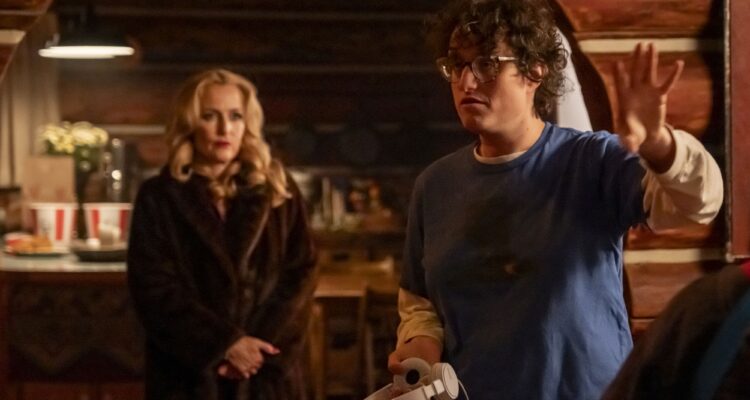
Nach We’re All Going to the World’s Fair und I Saw the TV Glow präsentiert Jane Schoenbrun ihren neuesten Film Teenage Sex and Death at Camp Miasma (Kinostart: 20. August 2026) in der Nebensektion Un Certain Regard der Filmfestspiele von Cannes. Trotz einer im Vergleich zu ihren früheren Werken aufgelockerten Tonalität ist auch dieser Film von den persönlichen Erfahrungen und Inspirationen der non-binären Filmemacherin durchzogen. Kurz nach der Premiere treffen wir Jane Schoenbrun in Cannes und sprechen über die Neuerfindung des Horrorgenres, Sex, Selbstfindung sowie Gender-Identität in Slasher-Filmen.
Ich finde es sehr bemerkenswert, wie viel von deiner eigenen Persönlichkeit, Identität und deinen Ideen du in einem Film wie diesem unterbringst. Du versteckst dich nicht hinter den Referenzen, sondern nutzt sie, um etwas Persönlicheres über dich selbst zu offenbaren. Kannst du darüber sprechen, wie du sie als Zugang zu etwas Intimerem nutzt statt als Schutzschild?
Absolut. Ich glaube, da steckt etwas fast Poststrukturalistisches drin.
Der Film existiert nicht einfach nur für sich selbst. Er steht in einer Tradition von Slasherfilmen, queeren Filmen und Filmen ganz allgemein. Und ich mag es, den Film gewissermaßen mit Fußnoten zu versehen. Nicht um der bloßen Referenzialität willen, sondern um Themen und Aussagen zu vertiefen. Ich kann ein paar Beispiele nennen, die sich speziell auf das Genre beziehen, in dessen Tradition der Film am deutlichsten steht: das Slasher-Genre. Natürlich gibt es Psycho als zentrale Referenz. Es gibt Verweise auf Das Schweigen der Lämmer, Sleepaway Camp und Dressed to Kill. Außerdem finden sich viele Bezüge zum Psycho-Remake, das ich unglaublich faszinierend finde.
Doch wenn man sich mit diesem Werkkanon in einem Film auseinandersetzt, der selbst von einem Remake dieses Genres handelt, dann gab es für mich als queere und trans Person, die über geschlechtliche Abweichung im Slasher-Genre sprechen möchte, keinen subtilen Weg. Dieses Genre hat unsere kulturelle Vorstellung von transsexuellen Menschen geprägt und damit auch meine eigene Vorstellung von mir selbst.
Ich brauchte diese Referenzen. Ich brauchte das Lächeln aus Sleepaway Camp im Film. Wir sehen Jack genau dieses Grinsen zeigen, das den Film damals berühmt abgeschlossen hat und das für mich ein ikonisches, aber auch schädliches trans Bild darstellt.
Daneben gibt es viele weitere Referenzen und ich finde diese Geschichte unglaublich spannend. Da gibt es beispielsweise eine Zeile, die bislang kaum jemand aufgegriffen hat. Gillian sagt zu Chris: „Du machst mir keine Angst. Ich habe für The Burning vorgesprochen.“
The Burning ist einer dieser Freitag-der-13.-Abklatsche, die unmittelbar danach erschienen. Der Film ist gemeiner, blutiger, gewalttätiger und misogynischer. Außerdem trägt er berüchtigterweise einen „Story by“-Credit von Harvey Weinstein. Er hat sich sogar einen „Created by“-Credit gegeben. So etwas sieht man selten. Und man spürt es.
Ein weiteres Beispiel ist die Referenz auf Jamie Lee Curtis. Damit mache ich mich ein wenig lustig. Es gibt einen Witz über das hartnäckige Gerücht aus der Zeit vor dem Internet, sie sei intersexuell. Aber genau das ist doch interessant, oder? Unsere bekannteste Final-Girl-Figur wird nicht nur mit Misstrauen betrachtet oder als etwas maskulin wahrgenommen. Nein, man kommt direkt zu dem Schluss: Sie muss ein Mann sein. Was passiert da eigentlich in unserem kulturellen Unterbewusstsein?
Und dann ist da natürlich Psycho, die für mich ikonischste und grundlegendste Referenz. Die Duschszene ist für mich nicht nur ein Grundlagentext des Genres, sondern auch ein Grundlagentext der Nachkriegsgeschichte von Geschlecht und Sexualität.
Im Film gibt es diesen Witz, aber nehmen wir ihn einmal ernst: Wie würde ein Psycho-Remake aus der Perspektive des Duschvorhangs aussehen? Auf der einen Seite des Vorhangs steht der Killer, auf der anderen das Opfer. Voyeur, Betrachtete, Phallus, nackte Frau. Gewalt und Begehren verschmelzen zu dieser typisch hitchcockschen, freudianischen Mischung. Hitchcock war ein Meister darin, seine Bilder mit einer solchen freudianischen Kraft aufzuladen, dass sie kulturelle Spuren hinterlassen. Dann entsteht daraus etwas, das mein Leben bis heute ein wenig schwieriger macht: die Angst vor dem Mann in Frauenkleidung auf der Toilette. Diese Angst existiert noch immer. Das ist Hitchcock. Das ist buchstäblich „Gender Trouble“.
Das ist nicht einfach deshalb im Film, weil „Norman Bates als Frau verkleidet“ eine verrückte Idee wäre. Geschlechtliche Abweichung ist etwas, das überläuft. Sie verfolgt die heteronormative Sexualität des 20. Jahrhunderts wie ein Gespenst. Sie ist der sprichwörtliche Elefant im Raum. Und wir sind davon besessen. Nicht ich bin davon besessen. Ich bin nicht die erste Person, die einen Film über Geschlecht im Slasher-Genre macht. Slasherfilme sind Filme über Geschlecht.
Was ich versuche, ist eine andere Perspektive einzunehmen. Nicht einfach dieselben Bilder Jahr für Jahr in dieser Dichotomie aus Angst und Begehren zu reproduzieren, sondern zu hinterfragen, woher diese Bilder kommen und wie ein Remake aussehen könnte, das diese Ideen tatsächlich weiterentwickelt.
Ich finde besonders faszinierend, wie ein einzelnes Bild das ganze Leben prägen kann. Sie erinnert sich ihr ganzes Leben lang an den Blick des Final Girls. Das erleben wir alle. Wir sehen etwas, das uns formt. Wir richten den Blick auf ein kleines Detail und plötzlich wird es größer als das Ganze.
Das habe ich auch in I Saw the TV Glow gesehen, diese Idee, wie Buffy durch die Linse einer bestimmten Beziehung zu The Pink Opaque wird. Wann hast du angefangen, dich mit dieser Idee auseinanderzusetzen?
Freud hat dafür ebenfalls einen Begriff: die Urszene. Er beschreibt damit den Moment, in dem ein Kind seine Eltern beim Sex beobachtet, bevor es überhaupt versteht, was Sex ist. Man wird mit einem Schrecken konfrontiert, für den man noch keinen Namen hat, und gleichzeitig mit einem Begehren. Dieser Moment ist buchstäblich unfassbar. In diesem ersten Kontakt mit etwas Sexuellem liegt etwas Ursprüngliches. Es hinterlässt einen Abdruck.
Im Film wird das wiederum zu einer Metapher. Sexualität ist etwas, das wir ständig neu erschaffen. Zumindest nach Freud. Wir reproduzieren die Urszene unser ganzes Leben lang, genauso wie das Camp-Miasma-Franchise im Film immer wieder neu aufgelegt wird. Es gibt eine Szene im Film-im-Film, in der Jungen an einem Kraftmesser stehen. Die junge Version von Gillian Andersons Figur, gespielt von Amanda Fix, sagt: „Seltsames Paarungsritual.“ Das ist gewissermaßen meine These. Dass all das ein seltsames Paarungsritual ist. Hannah versucht dieses Gefühl nachzubilden, das sie beim ersten Blick in diese Augen gespürt hat, selbst wenn sie es nicht benennen kann. Gillian versucht ihrerseits, ein ursprüngliches Trauma nachzustellen. Jenen Moment, in dem ihre Figur diesem anderen Blick begegnet und etwas ähnlich Erschütterndes empfindet. Sie verarbeitet das obsessiv immer wieder in ihrer Kunst.
Vielleicht versuche ich zu sagen, dass wir als Kultur alle immer wieder dieses ursprüngliche Trauma reproduzieren, das Trauma unseres sexuellen Begehrens und unseres Daseins als sexuelle Wesen.
Wie empfindest du es, dass die Figuren bis zu einem gewissen Grad zwangsläufig Stellvertreter deiner selbst sind? Viele deiner persönlichen Erfahrungen, insbesondere nach deinen ersten beiden Filmen, spiegeln sich auch in ihren Erfahrungen wider. Mich interessiert dabei vor allem auch der Umgang mit dem kommerziellen Kino.
Ja. Ich habe inzwischen zwei Filme mit echtem Hollywood-Geld gemacht. Nicht viel nach Hollywood-Maßstäben, aber definitiv mehr Geld, als ich jemals hatte. Das Budget dieses Films lag irgendwo zwischen acht und neun Millionen Dollar und dafür muss man eben einige Zoom-Calls mit bestimmten Männern führen.
In vielerlei Hinsicht ist dieser Film ein Film über Freude und queere Befreiung durch Kunst. Es hätte sich unehrlich angefühlt, wenn die Auseinandersetzung mit dem kommerziellen System, das die Finanzierung ermöglicht, nicht Teil des Films gewesen wäre. Genauso wie das Gefühl, als trans Künstler in einem System zu arbeiten, das meine Werte nicht teilt. Der Rest macht einfach Spaß. Natürlich mache ich mich mit dem ganzen „Dieser Teil ist transfeindlich“-Ding auch ein wenig über mich selbst lustig.
TV Glow war ein sehr persönlicher Film, der aus einem intensiven Moment meines Lebens entstand. Genau deshalb hat er so viele Menschen berührt. Was mich bei diesem Film besonders freut: Viele Zuschauer, selbst viele Leute aus Hollywood, sind überrascht, dass der Film lustig und selbstreflexiv ist. Es gibt diese Annahme, dass man bei einem trans Film jetzt sein Gemüse essen müsse. So nach dem Motto: „Na gut, die Queers sagen, dieser Film sei wichtig, also schauen wir ihn uns an und versuchen herauszufinden, worum es geht.“ Ich versuche die Zuschauer zunächst ein wenig für mich zu gewinnen, bevor ich vielleicht versuche, ihre Welt zu erschüttern.
Als ich Nope im Kino gesehen habe, hatte ich das Gefühl, dass Jordan Peele genau das gelingt. Er schaut dem Problem direkt in die Augen, wie man es bei einem Rodeo mit einem wilden Tier tut. Aber das, worauf sich dieser Blick richtet, ist genau diese Herausforderung: großes, kommerzielles Unterhaltungskino zu machen und es gleichzeitig mit komplexen Ideen aufzuladen, mit denen wir uns als Gesellschaft auseinandersetzen sollten. Genau das wollte ich auch. Ich wollte die Menschen einladen und ihnen zunächst Sicherheit geben, bevor ich sie herausfordere.
Der Film handelt auch von Schauspielerinnen und davon, wie Schauspielerinnen und ihre Körperlichkeit Filme in Hollywood prägen. Mich würde interessieren, inwiefern der Film auch eine Hommage an Schauspielerinnen ist und welchen Einfluss Gillian Anderson auf dich hatte.
Gillian war eine enorme Inspiration für mich. Als Kind habe ich X-Files-Fanfiction geschrieben. Mein wertvollster Besitz war meine Sammlung von X-Files-Romanadaptionen. Ich war ein ziemlicher Nerd. In einigen dieser prägenden Jahre habe ich fast ausschließlich an Akte X gedacht. Deshalb steckte natürlich etwas Emotionales und Meta-Ebenes im Casting. Als ich Gillian zum ersten Mal traf, war mein erster Gedanke: „Oh mein Gott, ich kenne dich bereits. Das ist so seltsam.“
Dann kommt sofort dieser Gedanke: Hast du mich irgendwie mit großgezogen? Für viele Menschen hat sie genau diese Rolle eingenommen. Für viele war sie ein queeres Erwachen. Und ich hoffe, dass man das im Film spüren kann. Das verleiht dem Film etwas, das niemand sonst hätte mitbringen können. Gleichzeitig verschwand dieses Gefühl sehr schnell, sobald ich sie näher kennenlernte. Irgendwann sieht man seine Kollaborateure einfach als Menschen. Und als brillante Menschen. Sie nimmt ihr Handwerk unglaublich ernst und bringt etwas mit, das sich für mich fast wie eine Theaterausbildung anfühlte. Sie war, wie viele großartige Schauspieler, vollkommen bereit für eine echte Zusammenarbeit, für eine tiefe emotionale Kollaboration. Sie brachte sich selbst, ihre Ernsthaftigkeit und eine enorme Verletzlichkeit mit ein. Dadurch wurde sie sehr schnell einfach zu einer Person, mit der ich diese besondere, aber sehr intensive Beziehung hatte, die zwischen Regisseur und Schauspieler entstehen kann, wenn die Zusammenarbeit funktioniert.
Was Schauspielerinnen betrifft, denke ich aber, dass der Film noch etwas anderes tut: Er lässt sehr viel klassisches Hollywood herein. Und die Schauspielerin ist natürlich ein zentraler Bestandteil dieses klassischen Hollywoods. Schon ihr erster Auftritt im Film stammt praktisch direkt aus dem Noir oder dem Melodrama. Die gemalten Hintergründe, diese überlebensgroßen Momente, für mich ist das die Essenz des Kinos.
Es ist eigentlich schade, dass man zu diesen alten Filmen zurückgehen muss, wenn man genau dieses Gefühl vermisst. Die Unvergänglichkeit eines Technicolor-Films gehört für mich zu den schönsten Dingen überhaupt im Kino.
Wenn ich darüber nachdenke, welche Geschenke ich mir selbst beim Filmemachen machen kann, dann versuche ich genau solche Momente zu erschaffen. Momente, die auf dieselbe Weise weiterleben können.
Ich habe einen lustigen Kommentar in den sozialen Medien gelesen, der Camp Miasma als die Slasher-Version von Porträt einer jungen Frau in Flammen bezeichnete, mit diesen beiden Frauen in diesem Setting. Deshalb würde ich gerne wissen, wie du dieses Begehren und die Sexszenen entwickelt hast. Céline Sciamma ist für viele ein wichtiger Bezugspunkt bei solchen Szenen. Welche Referenzen hattest du und wie wolltest du etwas Eigenes schaffen?
Natürlich gab es filmische und auch theoretische Referenzen zu Sexualität, die ich eingebracht habe. Aber vor allem ging es um meine eigene Beziehung zu Sex, über die ich möglichst ehrlich sein wollte. Bis ich zweiunddreißig war, hatte ich genau eine Person geküsst und mit genau einer Person Sex gehabt. Sexualität war für mich etwas, das ich vermieden habe. Sie war traumatisch. Es war eher dieses Gefühl: „Ich weiß, dass das ein Teil des Lebens ist. Irgendwie muss ich mich wohl damit auseinandersetzen.“
Nach meiner Transition, als ich begann, wirklich ich selbst zu werden, war Sexualität gleichzeitig beängstigend, wunderschön und bedeutsam. Ich glaube, eine gesündere Beziehung zu Sex zu entwickeln war ein wesentlicher Teil davon, ein vollständiger Mensch in dieser Welt zu werden. Und das begann letztlich mit Präsenz. Ich dachte mir: „Es ist mir egal, ob das gut oder schlecht ist. Ich möchte einfach da sein und es erleben.“
Als Gesellschaft sprechen wir oft darüber, dass Gen Z angeblich keinen Sex mehr hat. Warum ist das so? Für mich liegt die Antwort auf der Hand. Nicht nur, weil unsere Welt einsamer geworden ist, sondern auch, weil sie hässlicher geworden ist. Ein einziger Blick auf die Startseite von Pornhub genügt, um diese Hässlichkeit zu erkennen. Es überrascht mich nicht, dass viele junge Menschen Sex vermeiden wollen. Und es überrascht mich nicht, dass ich ihn vermeiden wollte.
Wenn man sensibel für Energien ist, kann selbst Begehren etwas Bedrohliches haben. Und oft gibt es gute Gründe dafür. Ich würde mir wünschen, dass der Film diesen Schmerz zumindest ein kleines Stück heilt, so wie ich selbst ein Stück Heilung erfahren habe. Genau diese Erfahrung steckt auch im Film.
Daher kommen letztlich auch die Sexszenen. Die Süßigkeiten spielen eine Rolle, weil es mir geholfen hat, mich an einen so beängstigenden Ort gemeinsam mit einer anderen Person zu begeben, wenn es jemand war, mit dem ich vorher und nachher einfach zusammensitzen und Gummibärchen essen konnte. Dieses Anfangen und Abbrechen ist wichtig. Wir sehen zunächst die traditionellste Sexszene des Films, eine Szene, die genauso inszeniert ist, wie man sich eine sinnliche französische Liebesszene vorstellen würde. Aber irgendetwas funktioniert nicht. Und sie endet so, wie sexuelle Erfahrungen vor meiner Transition oft für mich endeten: mit dem Gedanken: „Was zum Teufel stimmt nicht mit mir?“ Dann gibt es eine Unterbrechung und die beiden beginnen mit diesem Fantasiespiel. Sie betreten einen Raum, der provozierend ist und mit viel Scham verbunden scheint. Aber weil sie einander vertrauen, können sie in diesem Moment wirklich präsent sein und einen sicheren Raum für diese Art von Spiel erschaffen.
Ich wollte, dass der Film etwas Ähnliches macht. Denn genau dafür sind Filme und insbesondere Horrorfilme meiner Meinung nach da. Sie bieten einen sicheren Raum, um über die dunklen Dinge zu sprechen, die uns Angst machen. Deshalb gefällt mir auch die Tagline des Films: „Wenn es zu real wird, kannst du jederzeit abschalten.“ Das ist Einverständnis. Es sind zwei Menschen, die sich gegenseitig sagen: „Wir können jederzeit aufhören. Das ist ein Spiel. Das ist Fiktion.“ Natürlich wollen sie nicht aufhören, weil sie genau dorthin gelangen wollen, wo sie schließlich ankommen.
Wie bist du auf die Maske des Killers gekommen?
Ich war über Weihnachten bei den Eltern meines Partners zu Besuch und konnte nicht schlafen. Ich lag im Bett, starrte an die Decke und plötzlich dachte ich: „Da ist sie.“ Ich glaube, ich suche ständig nach Dingen, die sich direkt vor unseren Augen verstecken. Außerdem wusste ich, dass ich dem Film eine ikonische Slasher-Maske schuldete. Der Film brauchte sie. Es konnte nicht einfach eine weitere Hockeymaske sein. Damit der Film funktioniert, musste dieses Element eine starke eigene Identität und Ikonografie besitzen. Gleichzeitig durfte es sich nicht zu sehr wiederholen und auch nicht zu offensichtlich sein. Es musste etwas Einfaches sein, das sich trotzdem richtig anfühlt. Ich habe gelernt, dass genau solche Dinge oft zu den schwierigsten Teilen des Prozesses gehören. Meistens muss man einfach warten, bis sich die Idee von selbst zeigt. Und wenn sie dann da ist, sollte man ihr nicht zu viele Fragen stellen. Man spürt einfach, dass sie richtig ist.
Ein großer Teil des Films dreht sich darum, dass Kris vollständige kreative Kontrolle über das Camp-Miasma-Reboot haben möchte. Du hast vorhin davon gesprochen, mit Hollywood-Verantwortlichen telefonieren zu müssen. Wie viel kreative Freiheit hattest du letztlich bei diesem Film? Musstest du Kompromisse eingehen?
Ich hatte keinen Final Cut. Niemand hat mich letztendlich dazu gezwungen, etwas zu verändern. Trotzdem finde ich wichtig zu erwähnen, dass ich keinen Final Cut hatte. Das erzeugt eine gewisse Machtstruktur im Hintergrund, die während der gesamten Produktion auf einem lastet, besonders bei einem so persönlichen Film.
Abgesehen davon hatte ich in der Praxis sehr viel Freiheit. Natürlich gab es Momente, in denen meine Entscheidungen hinterfragt wurden, ich Anmerkungen bekam oder bestimmte Dinge verteidigen musste. Aber damit habe ich kein Problem. Im Gegenteil. Solange es aus der richtigen Motivation heraus geschieht, kann das einen Film sogar besser machen.
Ich versuche, denselben Prozess auch bei mir selbst anzuwenden. Ich hinterfrage meine Entscheidungen ständig. Das ist oft schmerzhaft, besonders bei Filmen wie diesem, die ziemlich prätentiös sein können. Man verliert sich leicht in den eigenen Gedanken. Dann zeigt man den Film Menschen und fragt sich plötzlich: „Moment, fühlen die überhaupt etwas dabei?“ Deshalb muss man immer bereit sein, selbst die Entscheidungen infrage zu stellen, in die man besonders viel investiert hat. Gleichzeitig hatte ich ein Team aus Mitarbeitern um mich herum, sowohl am Set als auch in der Postproduktion, denen ich vollkommen vertraut habe. Das war eine unglaublich befreiende Erfahrung, weil ich so etwas zuvor noch nie in dieser Form erlebt hatte. Alle Beteiligten waren Menschen, die ich mochte, und von denen ich wusste, dass ihnen die künstlerische Qualität des Films mindestens genauso wichtig war wie mir.
Wie beeinflusst dein kommendes Buch dieses Spannungsfeld zwischen Freiheit und Verantwortung?
Ich habe mir ein Tattoo stechen lassen, damit ich das Buch auch wirklich schreibe. Es war mein erstes Tattoo überhaupt. Ich hatte gerade TV Glow abgeschlossen und dachte: „Okay, ich werde dieses Buch schreiben. Aber ich muss sicherstellen, dass ich es wirklich tue. Also muss ich es mir auf die Haut schreiben.“ Deshalb ließ ich mir ein Tattoo stechen. Darauf steht einfach: „Make it real.“ Jack hat die Worte auf meinen Arm geschrieben.
Dieser Satz taucht auch immer wieder im Buch auf. Aber er ist zugleich eine Art Mantra. Vielleicht hängt das mit vielem zusammen, worüber wir gesprochen haben: die eigene Fiktion in Realität zu verwandeln. Etwas Flüchtiges, das nur in einem selbst existiert, greifbar und real werden zu lassen. Das Schreiben des Buches war wunderbar, weil mich dabei niemand gestört hat. Ich konnte mehrere Jahre lang jeden Morgen aufstehen, Kaffee machen und schreiben.
Ich liebe das Filmemachen und ich liebe die kollaborative Natur des Mediums. Aber wenn man am Set steht und für Hunderte Menschen mit ihren jeweiligen Bedürfnissen verantwortlich ist, ist das unglaublich anstrengend. In vielerlei Hinsicht ist das auch Managementarbeit. Deshalb war es sehr befreiend zu erkennen, dass ich mich einfach hinsetzen und schreiben kann was ich möchte.
Als das Buch fertig war, jemand es gekauft hat und ich tatsächlich Geld damit verdient habe, dachte ich, dass ich einfach das machen könnte. Ich werde nicht aufhören, Filme zu machen. Aber es hat mir ein Gefühl von Sicherheit gegeben. Hollywood kontrolliert nicht meine Fähigkeit, mich auszudrücken. Die kontrolliere ich selbst.
After “We’re All Going to the World’s Fair” and “I Saw the TV Glow”, Jane Schoenbrun premiered her latest film, “Teenage Sex and Death at Camp Miasma”, in the Un Certain Regard section at the Cannes Film Festival. Despite its lighter tone compared to her previous work, the film remains deeply rooted in the personal experiences and inspirations of the non-binary filmmaker. Shortly after the premiere, we met Schoenbrun in Cannes to discuss reinventing the horror genre, sex, self-discovery, and gender identity within the slasher films.
I find it very unique that you found so much of your own personality, identity, and ideas in a film like this. You don’t hide behind the references but use them to reveal something more about yourself. Can you talk about using that as a gateway to something more intimate instead of as a shield?
Jane Schoenbrun: Totally. I mean, there is something almost post-structuralist about it.
The film isn’t just a work unto itself. It exists within this lineage of slasher movies, queer movies, and movies in general. And I like to litter the film with footnotes in some way.
Not just for the sake of sheer referentiality, but to deepen themes and messages. I was talking about this during the last roundtable, but I’ll give you a few examples as they specifically relate to the genre the movie is most clearly in the tradition of, which is the slasher genre.
There is obviously a reference to Psycho as a primary reference. There are references to The Silence of the Lambs, Sleepaway Camp, and Dressed to Kill. There are also a lot of references to the remake of Psycho, which I find really fascinating.
But in interrogating this body of work in a movie that is also about a remake of this genre, obviously as a queer and trans person interested in talking about gender deviance in the slasher genre, which has done a lot to codify our cultural imagination of trans people and, as a result, my cultural imagination of myself, there was no way to do that in a way that was subtle. I needed those references. I needed the smile from Sleepaway Camp in the movie. We see Jack do that same grin that famously ends that movie, which is an iconic, damaging trans image, in my opinion.
But there are all of these other references, and I think it’s a fascinating history. There is this line that not many people have picked up on yet, where Gillian is telling Chris, “Oh, you don’t scare me. I auditioned for The Burning.” The Burning being one of these Friday the 13th knock-off movies that followed immediately on the heels of that film. It’s meaner, bloodier, more violent, and more misogynistic, and it is famously “story by” Harvey Weinstein. He actually gave himself a “created by” credit. You don’t see those in movies very often. And you can feel it.
Another one is the reference to Jamie Lee Curtis. It’s me taking the piss a little bit. There’s a joke about the persistent rumor that existed pre-internet that she was a hermaphrodite. But that’s interesting, isn’t it? That our most famous final girl is not only perceived with that kind of suspicion, not only seen as a little bit mannish, but literally as: she must be a man. What is happening there in our cultural subconscious?
And then, most iconically and most foundationally for me, there is Psycho. I think of the shower scene in Psycho not just as a foundational text of this genre, but as a foundational text of post-war twentieth-century gender and sexuality. There’s this joke in the movie, but to take the joke seriously for a second: what would a remake of Psycho from the perspective of the shower curtain actually look like? You have, on one side of the shower curtain, the killer. On the other side, you have the victim. Voyeur, voyee, phallus, naked woman. So you have violence and desire in all of its Hitchcockian, evocative, Freudian stew. He is a master at imbuing his images with this Freudian power that leaves a cultural dent.
And then what you have is one of the things that makes my life a little shittier: the fear of the man in women’s clothing in the bathroom. We still have that fear. That’s Hitchcock shit. That’s literal gender trouble. And it’s in there not just because, “Wouldn’t that be crazy if Norman Bates dressed up like a woman?” It’s because gender deviance is spillage. Gender deviance is this thing that haunts twentieth-century heteronormative sexuality. Gender deviance is the literal elephant in the room. And we’re obsessed with it. It’s not me who is obsessed with it. I am not the first person making a movie about gender in slasher films. Slasher films are movies about gender.
What I’m trying to do is maybe ask from a different perspective: not just, “Let’s remake that year after year in this libidinal fear-desire dichotomy that we’re still stuck in,” but to interrogate it and think about where that imagery comes from and what a remake that actually evolved it would look like.
I think what I find really fascinating is this idea of an image. She remembers the look in the final girl’s eyes for her whole life, and we see that many times in our lives. We see something that forms us. If we see it as an informative agent, we look into a small detail, and it becomes bigger than the whole thing. I saw that in TV Glow as well, this idea of how Buffy transforms into the Pink Opaque through the lens of this very particular relationship. Can you talk a bit about this idea? When did you first approach this?
Jane: Freud has a word for this too, right? It’s the primal scene. Literally, he hypothesizes this as the moment when, as a child, you see your parents having sex before you know what sex is, and you’re confronted with a terror you don’t even have a name for, and the desire of that moment. It’s quite literally unfathomable.
There’s something primal in that first seeing of something sexual, essentially, that imprints. This then, again, in my movie, becomes a metaphor of some kind. Sexuality, I think, in many ways, is something we are remaking. That is Freud’s estimation. We’re remaking the primal scene throughout our lives in the same way that they’re remaking the Camp Miasma franchise year after year. There’s a line in the movie within the movie where they’re watching the boys use a strength-tester machine, and the young version of Gillian Anderson’s character, played by Amanda Fix, says, “Strange mating ritual.”
That’s something of a hypothesis for this: that this is all a strange mating ritual. Hannah’s character has been trying to remake this feeling she had when she first saw that look in the eye, even if she can’t define what it was that felt so shattering and indelible.
Gillian has been trying to remake some originary trauma of that moment when her character in the movie entered that other gaze and felt something similarly earth-shattering. She is making her own art about it obsessively, over and over again.
I think what I’m trying to say, maybe, is that we are all culturally remaking this originary trauma, which is the trauma of our sexual drive and our being in the world as sexual people.
What do you feel about the characters being, to some extent, which is impossible to avoid, a stand-in for you? Obviously, your personal experiences, particularly since you made the first two films, are reflected in her personal experiences. I’m interested in talking about that, also specifically about her dealings with commercial cinema. You must have had some contact with that after two such highly praised films.
Jane: Yeah. I’ve now made two movies with real Hollywood money. Not much as far as Hollywood money goes, but still more money than I have. I think this movie’s budget was somewhere in the eight or nine million range, and yes, you have to get on some Zoom calls with some men to get that money. In so many ways, this is a movie about joy, and this is a movie about queer liberation through art-making. It felt like the movie would have been a lie if the process of dealing with commerce to get the movie made wasn’t in the text, as well as the ways in which that makes me feel insane as a trans artist trying to make honest, personal work in a system that doesn’t share my values.
And the rest of it is just fun. Obviously, I’m taking the piss out of myself a little bit with the “this part’s transphobic” thing. But it also felt like a really nice way to do something different. TV Glow was such a personal film that came out of this really visceral moment in my life, and I think that’s exactly why it resonated so strongly with other people.
One thing I’ve been really pleased with in sharing this film with people, and actually with a lot of those Hollywood types, is that they seem almost shocked when they first watch it that it’s funny and self-aware. I think there’s this assumption that if it’s a trans film, you’re going to have to eat your vegetables now. It’s like, “All right, well, let’s watch this one. The gays say this is important, so we have to watch it and try to understand what it’s about.”
There is a technique of trying to win you over a little bit before I maybe try to rock your world a little bit. I remember seeing Nope in theaters and feeling like that is a movie about threading the needle. It’s a movie about looking the thing in the eye, in the way that you do in a rodeo. But the thing that it’s looking in the eye is exactly this: making a blockbuster piece of commercial entertainment that is also imbued with really complex ideas that we, as a culture, should be engaging with.
I wanted this film to be that. I wanted to really invite people in and try to make something that would challenge them after making them feel safe.
The movie is also, I think, about actresses and how actresses and the corporeality of actresses shape movies in Hollywood. I wanted to know in what way it was also an homage to actresses for you, and in what way you were inspired by Gillian Anderson.
Jane: I was so deeply inspired by Gillian. I wrote X-Files fanfiction as a kid. My most prized possession was my X-Files novelization collection. I was a nerd. I was thinking mostly about The X-Files for a few of those formative years. So there was obviously something emotional and meta in the casting. When I first met Gillian, it was like, “Oh my God, I already know you. This is so weird.” And I know you like, did you raise me a little bit? For so many people, she has played that role. She really is, for so many people, this queer awakening. And I hope you catch a whiff of that in the movie. That adds something to the movie that no one else could have.
But at the same time, that very quickly went away for me as I got to know her. I very quickly thought, “Oh no.” And I knew this already, but you start to see your collaborators as people, and as brilliant people. She is so serious about her craft and brings what felt almost like a theater background to it. She, like many actors, was so ready for a true collaboration, a deep emotional collaboration. She brought herself and her seriousness to it and was incredibly vulnerable. So very quickly, she just became a person with whom I was having this very specific but very deep relationship, which is the relationship between a filmmaker and an actor when it works well.
In terms of actresses, I think more than that, the movie is letting in a lot of classical Hollywood, of which the actress is obviously such a huge part. Even the moment when she enters the movie is pulled directly from noir and melodrama. Our matte-painted backgrounds and these larger-than-life moments, to me, are the richness of cinema. It’s such a shame that you have to go back to those movies to get that particular fix when you’re missing it in cinema. The indelible nature of a Technicolor film is one of the things I love most in cinema. So when I think about what gifts I can give myself in making a movie, it’s about trying to create these rich moments that could live in that way.
I read a funny comment on social media saying that Camp Miasma is like the slasher version of Portrait of a Lady on Fire, with these two women in this setting. I would like to ask you how you worked to build this desire and the sex scenes, because Céline Sciamma is a reference point for this kind of scene. I don’t know which references you had, and how you built something new and different.
Jane: There are certainly cinematic references to sex and academic references to sex that I was bringing to the table, but primarily there was my own relationship to sex, which I was trying to be really honest about. Until I was thirtytwo, I had kissed and had sex with exactly one person, and sex was something that I avoided. It was traumatic. It was like, “Oh, I know that this is a part of life. I guess I have to deal with that somehow.”
And then after transition, as I started to become myself, it was both terrifying and very, very joyful and meaningful. I think learning how to have a healthier relationship to sex was an essential part of becoming a full person in the world. And that started with really just presence. I was like, “I don’t care if this is good or bad. I just want to be here experiencing it.”
As a culture, we talk a lot about this generational divide: Gen Z isn’t having sex. What’s that about? And I think it’s obvious what it’s about. Not only is it about how much lonelier a world we’re all living in, but it’s also about how much uglier a world we’re living in. It takes just one visit to the homepage of Pornhub to understand that ugliness.
It’s no wonder that these folks would want to avoid sex, and that I wanted to avoid sex. If you’re sensitive to energy, even desire can feel unsafe, and for good reason. I would like the film to heal that just a little bit, in the way that I felt healed. And the way I felt healed is reflected in the film.
That’s where the sex scenes come from. The candy is there because, for me to go to that scary place with somebody else, it really helped if it was somebody I could hang out with and eat gummy candy with before and afterwards. The starting and stopping. We see the most traditional sex scene in the movie, the scene that is shot like you would imagine a sexy French sex scene to be shot. But there’s something that’s not quite happening, and then it ends the way pre-transition sexual encounters would often end for me, which was with me thinking, “What the fuck? What’s wrong with me?” But then there’s a break, and they start to do this fantasy play. They’re able to enter this place that is provocative and that there is clearly a lot of shame around. But because they trust each other, they’re able to begin to be present together in this thing and create a safe place for that kind of play.
I want the movie to do a similar thing because I think that is, again, what movies, and specifically horror movies, are there for. It’s a safe place for us to talk about the darker things that scare us, in the same way that the tagline says, “If it gets too real, now you can turn it off.” That’s consent. That’s the two of them saying to each other, “We can stop this at any moment. This is play. This is fiction.” But of course they don’t want to stop it, because they want to get to where they eventually get to.
How did you come up with the killer’s mask?
Jane: I was at my partner’s parents’ house over Christmas, and I couldn’t sleep. I was staring up at the ceiling, and I was like, “There it is.” I think I’m always looking for the things that are hiding in plain sight in our world. I also knew I owed the movie one iconic slasher killer costume. The movie needed it. It couldn’t just be another hockey mask. For the movie to be good, that was an element that needed to have a lot of individuality and iconography.
It also couldn’t repeat too much, and it couldn’t be too on the nose. It needed to be something simple but right. I’ve learned that it’s one of the hardest parts of the process. You usually have to wait for that thing to present itself, and then, when it does, you don’t ask it too many questions. You feel it.
A big part of the film was Kris wanting to have full creative freedom in directing and creating the Camp Miasma reboot. You were talking about having to get on the phone and speak to people in Hollywood, but ultimately, how much creative freedom did you have in creating this movie? Were there any compromises you had to agree to?
Jane: I did not have final cut. No one ultimately forced me to change anything, but I think it’s worth saying that I did not have final cut on this movie. That creates this soft-power dynamic that weighs on you while you’re making a movie, especially a movie this personal.
Otherwise, thankfully, I had a ton of freedom in actual practice. There were certainly moments where I was being challenged, given notes, or questioned about choices, but I don’t mind that. I actually like that, as long as it’s coming from the right place. I think that makes the movie better, and I try to do that to myself too. I really interrogate my choices. It’s very painful, but especially with movies like this that are pretentious as fuck, I get so in my head about it. Then you actually make it and watch it with people, and you’re like, “Wait, are you feeling things, though?”
So you always have to be ready to question very deeply the choices that you’ve really invested in.
I also had a group of collaborators surrounding me on set and in post whom I trusted completely. That was a really revelatory experience because I don’t think I had ever quite had that before in the same way, where all the people going into the process of building the movie were people I loved and people I knew cared just as much, if not more, about each piece of artistry.
How does your upcoming book bleed into this sense of freedom versus responsibility?
Jane: I got a tattoo to make sure I wrote the book. My first ever tattoo. I had just finished TV Glow, and I was like, “All right, I’m going to write this book. I need to make sure I actually write it. I need to put it on my skin.” So I got a tattoo. It just says, “Make it real.” Jack wrote it on my arm.
That is a recurring line in the book: “Make it real.” But it’s also a mantra. It’s perhaps connected to some of the things we’ve been talking about, of making one’s fiction into reality. The creation of the thing becomes about trying to take this ephemeral thing that exists inside you and making it real. The book was lovely because no one bothered me while I wrote it. I got to wake up every day for a couple of years, make coffee, and write.
I love filmmaking, and I love the collaborative nature of filmmaking. But when you’re on set and you’re in charge of hundreds of people with feelings, that’s exhausting. It’s very managerial in a lot of ways. There was something very freeing about realizing that I can just sit down and write whatever I want and there aren’t millions of dollars I need to worry about. When I did it, and then when it was done and somebody bought the book and I made money from it, I was like, “Oh, I could just do this.” I won’t; I’ll keep making movies. But it gave me this sense of safety. Hollywood doesn’t actually control my ability to speak. I control it.
(Anzeige)